
Karma's a Bird
Finding and foiling my default programming

Tap tap tap.
Even though this noise occurs at regular intervals—every ninety minutes or so—it surprises me every time, making me look up from my work.
Tap tap tap.
Tap tap tap.
The tapping happens on three particular windows of my home: the dining room, my son’s bedroom, and weirdly enough, the family room on the other side of the house, just above the piano.
It’s not a neighbor trying to get my attention.
It’s not a wackadoodle delivery person.
It’s a bird—specifically, a robin, one of the most common birds in the Midwest, the bird often believed to herald the arrival of spring with its singing. Ugh—if only he were singing.
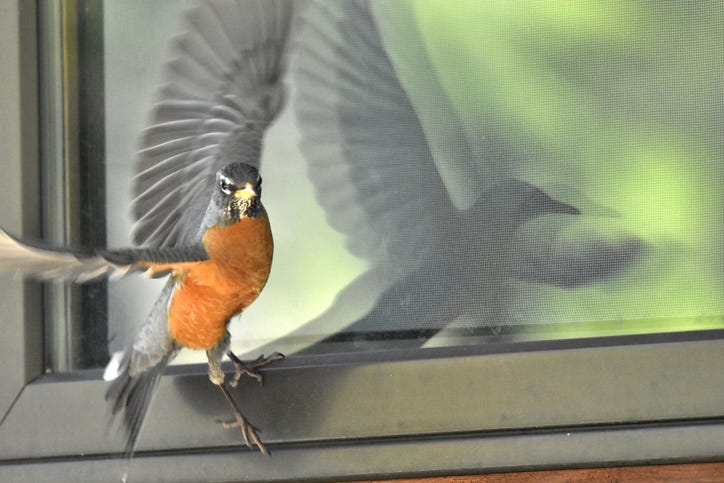
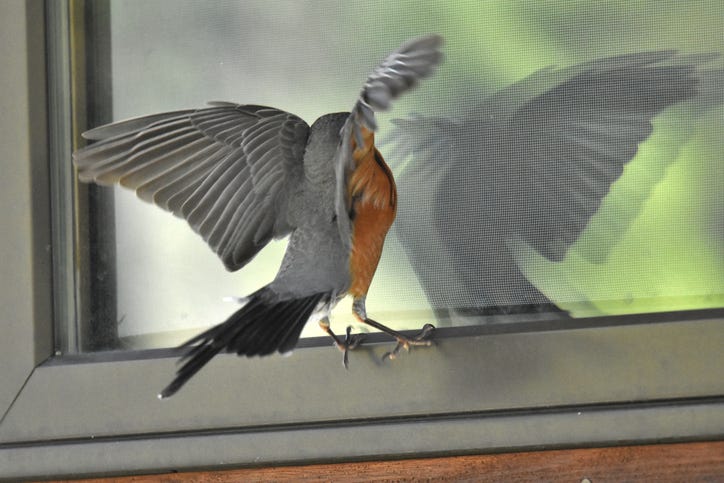
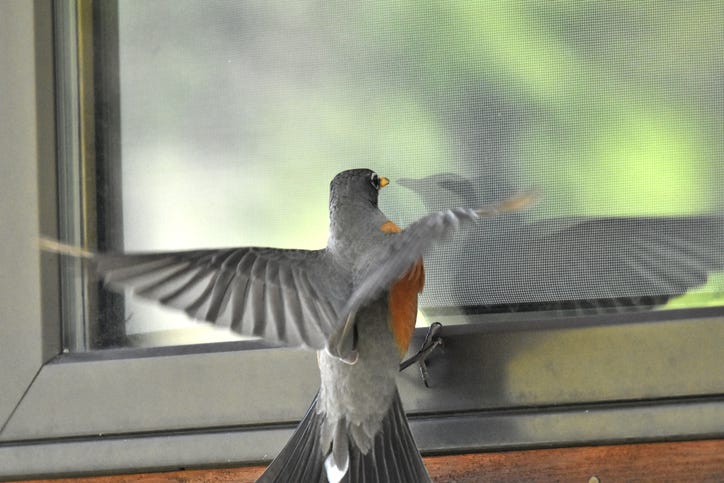
When the sound draws me to the window, I see him darting, flaring, rising, and dipping between taps. I suspect he’s also laughing at having successfully drawn me away—again—from my task, but his behavior obviously has nothing to do with me.
A little research lets me know that the robin, seeing his own reflection in the glass, likely believes it’s a rival bird invading his territory of blossoms, branches, and of course, bird-women. He’s defending that territory, signaling his willingness to battle.
I think about the rut in which this poor bird is caught—reacting automatically to his nonexistent rival, wasting his limited energy and resources, endangering his tiny beak—only to do it all over again after another hour. And it makes me think about my own way of existing in the world, and how much of it is habitual, compulsive, and utterly unthinking.
***
On the first day of a recent week-long writing conference, I sat quietly in the meeting room, listening to the conversations happening around me—the introductions and exchanges of information on hometowns, children, careers, pets. All of us were there to learn techniques for capturing our life stories in nonfiction formats.
Even while sitting among these lovely, engaged folks, I could feel my usual foibles rise to the surface, the default programming that originated during my childhood. I’m not likeable, not interesting, not enough. I could almost see those assumptions around me—darting, flaring, rising, dipping like frightened and frenzied little birds.
In Eastern philosophy, that default programming is considered part of our karma—the intricate mechanism whereby all of our past actions, and their related consequences, influence our future and destiny. I could sense my own programming activating, like a tapping on glass. I could feel myself fold in and close off.
We started an ice-breaker exercise common to all group activities (one I dread), going around the room, introducing ourselves. We were asked to share what we wanted to write about that week.
When my turn came, I felt my usual fears coursing through those old grooves and ruts in my mind, shouting at me to retreat, retreat, retreat.

So I opened my mouth to give a bland and forgettable answer, so that the spotlight would shift as quickly as possible to the next person.
Then, I paused. I took a breath. And I chose a different and much more personal answer.
“I’m writing to understand why I feel I don’t belong anywhere.”
The answer seemed to thud to the floor, and I almost couldn’t believe I’d verbalized how I genuinely, truly felt—something that made me feel exposed and unsafe. But before my embarrassment could ignite, I felt the energy of the room shift around me. I felt the kindness and empathy that vulnerability generates.
That experience might seem like a minor one, but it remained with me over the course of the week as I paid deeper attention to my default programming, and as I experimented with changing that programming: speaking up when I’d rather slip into silence, sharing details of my work instead of deflecting, approaching and engaging when I would have felt more comfortable holding back.
Did I become a new person? No. But I could feel a bit of rust clearing from my interiority. I could sense a shift in those internal ruts that hold my habitual reactions and prevent me from growing, changing, thriving—and maybe even a shift in how my future will unfold.
Indeed, I barely scratched the surface of my internal programming. As I entered the classroom on the last day and headed to my seat, a lovely new friend invited me to sit at her table. I accepted with gratitude and set my notebook down, but noticed an odd internal pull toward the table where I was originally headed.
I realized I’d been sitting in the exact same seat all week, creating yet another unthinking habit, another rut that my new friend had helped me to observe.
It was a striking reminder that my life is made up of innumerable small moments. And in each of those moments, before I dart and flare and rise and dip, before I wildly tap the glass, I can instead pause and choose. I can choose vulnerability. I can choose trust. I can choose connection.
I can choose.
Notes on Grief . . . and Kindness


Mother’s Day took me by surprise. Over the past few years, I thought my grief was softening, its peaks shortening, but then a fresh wave gob-smacked me.
I went to a shop to purchase white orchids, the same flowers I presented to my mother on her final Mother’s Day, and found myself mute with sadness when the cashier checked me out. Struggling to find my voice, I asked her for a small box to transport the vase.
She assured me it would be no problem, and I watched her cross the entire store and dig patiently through the floral section to find the right container for me. That’s when tears came, as I remembered how my mother took time and trouble like that, always, for anyone who needed help.
I wish I’d told the cashier she reminded me of my mother. Instead, I merely thanked her, embarrassed by my tears, and took the orchids to my car.
I drove to Eagle Creek Park, to a bench that’s dedicated to my mother’s memory and that overlooks the water she loved so much. Hours slipped by as I let myself simply sit and think about my time with her. I realized she lives on when I see her in others, when I notice and witness the countless small acts of kindness in the world.
What I’m Reading and Listening to:

Latitudes of Longing by Shubhangi Swarup. These three intertwined novellas are a uniquely beautiful combination of magical realism and eco-fiction, whose characters are struggling through pain and loss against the backdrop of cataclysmic environmental and political events.
The Correspondent by Virginia Evans. I was always a letter-writer, even well into adulthood, until it seemed to become an obsolete form of communication. How delightful, therefore, to see an epistolary novel set in today’s world, and to observe how letters open a portal through which to view a life, with all its hope and longing. (Here’s a link to my LitHub essay on this topic!)
Qwerty. This podcast is hosted by Marion Roach Smith, a beautiful writer of nonfiction (and the leader of our conference!). I particularly enjoyed this interview of Indiana writer Melissa Fraterrigo, author of The Perils of Girlhood, about the way writing our personal stories uncovers the deep meaning underlying our daily lives.
Thank you for being here!
Would you? If you’re on social media (Facebook or Instagram), please consider following me. (I’ll follow back!)
If you’d like to receive updates on my book, 108: an Eco-Thriller, and my other news and events, please sign up here. I appreciate your interest!
Thank you to everyone who has been a part of my writing journey. I am deeply grateful for your support and encouragement!
-Dheepa
I agree with Mary--a wonderful comparison to the robin's tapping. I needed to hear this story today. Thank you. :)
This was a really lovely reflection, thank you for sharing it, Dheepa.